
AI-Powered Behavioral Health Orchestration for Whole-Person Care
Six Lessons from BHT 2026
October 1, 2026
Demand for behavioral health support has grown steadily since COVID-19, and organizations across the market have expanded access in response, often with the help of digital tools. More people are getting help today who would not have received it before.
However, access alone does not ensure people reach the support that fits their needs. When demand grows faster than the systems designed to guide it, people can end up in care that is too intensive, not intensive enough, or simply the wrong match.
“There’s a gap in how we manage that demand, so it doesn’t drive up costs unnecessarily and we get better value from the increased access,” said Clay Nicholas, our chief commercial officer.
We explored that challenge on the main stage at Behavioral Health Tech 2026 in Nashville alongside partners from Blue Cross and Blue Shield of North Carolina and California’s Valued Trust (CVT). Michael Burcham, chief of strategy, research & talent development at Shore Capital Partners, moderated.
Throughout the conversation, one idea came through clearly: the next phase of behavioral health is powered by precision, using data to guide each person to the right level of support at the right time and personalizing that support as their needs change. Done well, that improves quality of care while lowering total cost of care.
Bringing Triage to Behavioral Health
Every system that manages demand well has a way to sort needs quickly. Nicholas learned that as a combat medic, when he was trained to assess the wounded on the battlefield. He had to decide quickly who could be treated in place, who needed to be stabilized until further care arrived, and who needed immediate evacuation to trauma care.
“Although you can’t treat mental health and think about it the same way as wounded soldiers on a battlefield, there is still that triaging mechanism that’s needed,” Nicholas said. “I do see a gap in how we use data to better understand what types of risks we’re dealing with at a population level so you can address risk early and get people to the right place and how you also use that data to personalize and deliver care once people are in that journey.”
Most organizations don’t yet have that mechanism working at a population level, and the gap shows up in two places. The first is understanding what types of risk exist across a population, so needs can be addressed early. The second is using that same insight to personalize care.
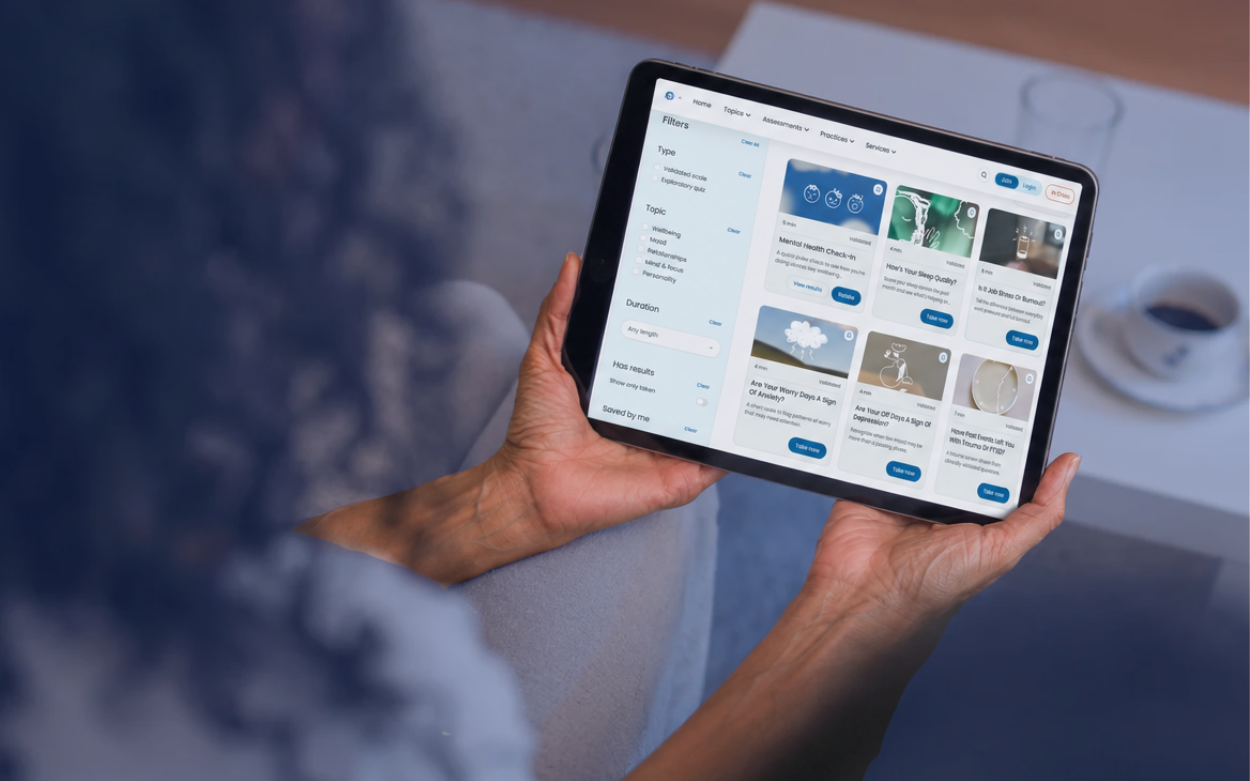
Screening addresses both. Assessments are the most-used tool on our platform, so members regularly share how they are doing. That information shapes what they see next, from self-care resources to a match with the right provider.
Meeting People Before the Clinic
Not everyone who is interested in receiving support needs clinical care as a first step. Jenny Cooper, principal product developer for behavioral health at Blue Cross NC, described a group of members she calls “behavioral health curious.” These are people who want to learn more but tend to shy away from clinical intervention, especially up front. A provider-neutral Digital Front Door gives them a low-pressure place to begin. From one entry point, members can explore self-care, complete a screening, and be guided to the right care across the plan’s full provider network, rather than toward any single vendor.
Blue Cross NC’s data points to the same need from another angle.
“What we see in the data is that there is an overwhelming number of folks that just go to one or two therapy sessions,” Cooper said. “That tells us that maybe they didn’t need treatment or they didn’t align with their treatment provider. But something’s not working if that’s what we’re seeing in the data.”
In response, Blue Cross NC is shifting its model so that self-care and self-directed options come first. That approach reflects what we see across our platform, where 3 in 4 people prefer to start with self-care.
A self-care first step still requires a fast path to clinical help. Blue Cross NC works with CredibleMind and its own call center so that members in crisis receive immediate support. They don’t have to wait days or weeks to speak with a therapist.
Personalization Builds Trust
When someone is ready for a clinician, the quality of the match matters. Many people are unsure what to look for when searching for a therapist, and behavioral health needs vary as widely as provider specialties do. Precise matching on need, acuity, and expertise helps people connect with a provider who can serve them well. It also helps avoid the one-or-two-session pattern Cooper described.
Personalization matters at every other point in the experience, too. As Nicholas explained, “It’s hard to build trust if a member is coming to an app or a site and it feels like it’s the first time you’ve talked to them when they’ve been there multiple times before, or if they’ve shared the same information multiple times before.”
Data sharing makes that continuity possible. Because Blue Cross NC shares data with CredibleMind, its members see information tailored to them. Through the plan’s Youth Signature Initiative, parents can also use the platform to better understand what is happening in their child’s life.
Engagement also depends on reaching people where they are. CVT, which has partnered with CredibleMind for about six years, runs quarterly assessments with its membership and encourages participation through gift card drawings. Those assessments bring members to CVT’s CredibleMind site to explore self-care. For anyone who wants to talk with someone, the trust’s employee assistance program is linked on the same page.
Addressing the Whole Person
Physical and behavioral health needs rarely arrive separately. “We’re a whole person, and what happens to us physically also affects you mentally,” said Robin Wood, health program manager at CVT. She described the Trust’s work to break down the silos between behavioral and physical health and meet members where they are.
The financial case is significant. When a physical health condition comes with a behavioral health need, the cost of care can run roughly 3 to 5 times higher, which is why whole-person care is core to our strategy.
For people already managing a physical condition, digital behavioral health support can wrap around the care they’re receiving. For example, when someone is discharged from a hospital with a specific condition, we can reach out early in their recovery with coping resources and services instead of waiting for them to seek help.
Using AI Responsibly
Data and AI make personalization possible at population scale, but they also carry risk. Some emerging approaches in the market, such as facial and voice recognition for earlier detection, are still early and largely unproven at scale . Over the next 12 months, we plan to introduce large language model chat and AI coaching to our platform.
Safety was a shared priority. Cooper noted that Blue Cross NC is focused on using AI safely and responsibly. At CredibleMind, we developed our own framework for managing AI risk, called VERIFY, and we hold ourselves accountable to it. VERIFY sets out six commitments partners can check for themselves, from human-vetted content and plain-language AI disclosure to partner-level controls and ongoing bias monitoring.
Moving From Access to Precision
For health plans, employers, and communities, the next step is to personalize the experience and make it relevant for an individual at that particular moment in time. This is precision behavioral health.
Expanded access opened the door for millions of people. The opportunity now is to make sure each of them reaches support that fits.
For organizations evaluating where to begin, a useful starting question is this: Once someone reaches your Digital Front Door, how do you know where they should go? Your own data can help answer it. Signals include:
- short therapy episodes,
- underused benefits, and
- members with physical health conditions who have never been screened for behavioral health needs.
Take the Next Step
If your organization is ready to move from expanded access to precision behavioral health, we can help you build that path.
- Want the full conversation? Watch the session on demand.
- Connect with us to explore how Precision Behavioral Health Orchestration can support your members.
- Check out our latest blog to learn more about how plans route members to the right level of support across the benefits and network they already have.
- Learn more about our VERIFY framwork by visiting our AI Trust Center.
Ready to Light the Path to Better Mental Health?
Explore the related resources

Precision Behavioral Health: AI-Powered Orchestration for Whole-Person Health
Access to behavioral health care has expanded, and so has spend. This 2026 BHT executive panel explains how plans tell members apart before cost and acuity climb.
Why Health Plans Need Precision Behavioral Health
Traditional BH models react to crisis. Learn how precision behavioral health meets members earlier—and what health plans gain.

What It Takes to Turn Access to Impact
Population behavioral health becomes transformative when hospitals measure what turns a promising idea into a sustainable, scalable model.